![[HOME]](https://ftp.funet.fi/index/Tree_of_life/icons/home.gif)
![[INDEXES]](https://ftp.funet.fi/index/Tree_of_life/icons/warp.gif)
![[TREE]](https://ftp.funet.fi/index/Tree_of_life/icons/phylo.png) Life
Insecta
Lepidoptera
Ditrysia
Noctuoidea
Noctuidae
Xyleninae
Life
Insecta
Lepidoptera
Ditrysia
Noctuoidea
Noctuidae
Xyleninae
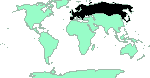 EU - Russia, Japan. See [maps]
Vielzahn-Johanniskrauteule
Purple Cloud
Hammaskuismayökkönen
EU - Russia, Japan. See [maps]
Vielzahn-Johanniskrauteule
Purple Cloud
Hammaskuismayökkönen
![[polyodon-1.jpg]](https://ftp.funet.fi/index/Tree_of_life/insecta/lepidoptera/ditrysia/noctuoidea/noctuidae/xyleninae/actinotia/_polyodon-1.jpg) 508x559 (~30Kb) Germany, Baden-Württemberg, Schönenberg, Siedlungsbereich (8°49'E, 48°57'N, 250m), 30.07.2001, Photo © Karl Hofsäß
508x559 (~30Kb) Germany, Baden-Württemberg, Schönenberg, Siedlungsbereich (8°49'E, 48°57'N, 250m), 30.07.2001, Photo © Karl Hofsäß
|
![[polyodon-2.jpg]](https://ftp.funet.fi/index/Tree_of_life/insecta/lepidoptera/ditrysia/noctuoidea/noctuidae/xyleninae/actinotia/_polyodon-2.jpg) 834x708 (~126Kb) Russia, Moscow area, 27.7.2010 (36°25'E, 56°23'N), Photo © D. Smirnov
834x708 (~126Kb) Russia, Moscow area, 27.7.2010 (36°25'E, 56°23'N), Photo © D. Smirnov
|
![[polyodon.jpg]](https://ftp.funet.fi/index/Tree_of_life/insecta/lepidoptera/ditrysia/noctuoidea/noctuidae/xyleninae/actinotia/_polyodon.jpg) 500x520 (~44Kb) FINLAND: Ka: Virolahti, 671:53, m+f 10-16.6.1995, Markku Savela leg.
500x520 (~44Kb) FINLAND: Ka: Virolahti, 671:53, m+f 10-16.6.1995, Markku Savela leg.
|
Larva on (in flowers and pods) Hypericum , H. maculatum, H. perforatum [SPRK]
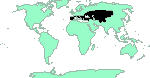 SEU, Turkey, Armenia, Turkmenistan, C.Asia. See [maps]
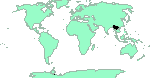 N.Vietnam. See [maps]
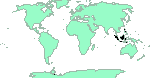 Borneo, Sulawesi. See [maps]
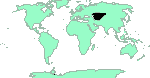 W.Turkestan. See [maps]
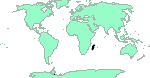 Madagascar. See [maps]
11.6.2023 (9)
Transgender people have profoundly influenced broader LGBTQ culture through art, language, and community building.
: The shift toward the LGBTQ+ acronym at the end of the 20th century reflected a growing movement to connect trans, bisexual, and queer struggles into a unified front for social change. senior shemales tgp extra quality
Transgender women of color experience disproportionately high rates of violence. Originating in the Black and Latine trans communities
Originating in the Black and Latine trans communities of New York City, ballroom culture gave us "voguing," "slay," and the concept of "chosen families." Understanding this intersection is crucial, not just for
Transgender and gender-diverse roles have existed across cultures for millennia:
For decades, the public face of the LGBTQ+ movement has often been symbolized by the rainbow flag—a vibrant, inclusive emblem representing the beauty of diversity. However, within that spectrum of colors, the contributions, struggles, and unique identity of the hold a distinct and often misunderstood position. While inextricably linked to LGBTQ culture, the transgender experience is not synonymous with LGB (lesbian, gay, bisexual) experiences. Understanding this intersection is crucial, not just for allies outside the community, but for the cohesion of the movement itself.
The transgender community is currently leading the most significant cultural conversation of the 21st century: the decoupling of biology from destiny. As Gen Z and Gen Alpha embrace gender fluidity at record rates, the "transgender experience" is becoming less of a niche subculture and more of a blueprint for how everyone—queer or straight—can live more authentically.
Transgender people have profoundly influenced broader LGBTQ culture through art, language, and community building.
: The shift toward the LGBTQ+ acronym at the end of the 20th century reflected a growing movement to connect trans, bisexual, and queer struggles into a unified front for social change.
Transgender women of color experience disproportionately high rates of violence.
Originating in the Black and Latine trans communities of New York City, ballroom culture gave us "voguing," "slay," and the concept of "chosen families."
Transgender and gender-diverse roles have existed across cultures for millennia:
For decades, the public face of the LGBTQ+ movement has often been symbolized by the rainbow flag—a vibrant, inclusive emblem representing the beauty of diversity. However, within that spectrum of colors, the contributions, struggles, and unique identity of the hold a distinct and often misunderstood position. While inextricably linked to LGBTQ culture, the transgender experience is not synonymous with LGB (lesbian, gay, bisexual) experiences. Understanding this intersection is crucial, not just for allies outside the community, but for the cohesion of the movement itself.
The transgender community is currently leading the most significant cultural conversation of the 21st century: the decoupling of biology from destiny. As Gen Z and Gen Alpha embrace gender fluidity at record rates, the "transgender experience" is becoming less of a niche subculture and more of a blueprint for how everyone—queer or straight—can live more authentically.
If you have corrections, comments or
information to add into these pages, just send mail to
Markku Savela
Keep in mind that the taxonomic information is copied from various sources, and may include many inaccuracies. Expert help is welcome.